An art catalog is a curated assembly of artworks gathered by an individual, institution, or group, often reflecting the collector's interests, tastes, or a specific theme.
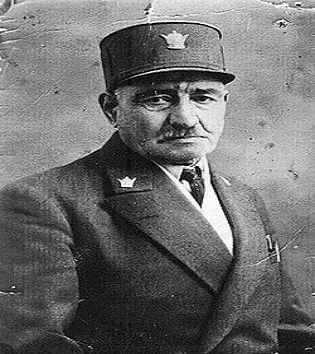
He was one of the masters of Nasta'liq calligraphy over the past century and a proponent who further developed the distinctive style of Mirza Kalhor. His life was not without hardship, largely due to his membership in the "Punishment Committee" (Komiteh-ye Mojazat); apart from his final years—when he held a court position and lived in comfort—the rest of his life was marked by turbulent events.
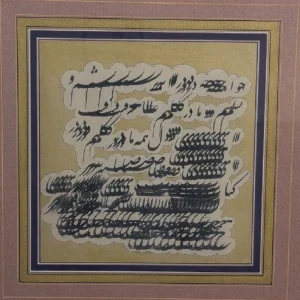
Mirza Mohammad-Hossein Seifi Qazvini was born in Qazvin on April 16, 1861 (1285 AH), and spent the greater part of his life practicing and teaching the *Nasta'liq* style of calligraphy. His father was a deed writer, and his mother belonged to the Seifi *Sayyid* family of Qazvin; it was due to his mother's *Sayyid* lineage that he was given the title "Mirza." He studied calligraphy for a time under Mirza Mohammad-Ali Khoshnevis. At the age of fourteen, he traveled to Baku (Badkubeh) to work for a merchant from Shirvan. When he was sixteen, he set out on foot for the *Atabat* (the holy shrines in Iraq); he remained in Kazimayn for three years, earning a living through his calligraphy. It is said that his financial hardship was so severe that he could not even afford to travel to Karbala. Eventually, he accompanied a religious scholar to Karbala and resided there and in Najaf for five years, studying religious sciences alongside his calligraphic work; finally, weary of poverty, he returned to Iran. He stayed in Tehran for two years and got married. In 1892, he established a calligraphy school on Naser-Khosrow Street, naming it "Dar al-Ketabeh" (House of Calligraphy). He calligraphed a copy of Ferdowsi's *Shahnameh* for Mozaffar al-Din Shah, earning the title "Emad al-Kottab" (Pillar of Scribes) in recognition of this achievement. During the Constitutional Revolution, he joined the ranks of the freedom fighters, and following Mohammad-Ali Shah's coup d'état, he was forced to flee and live as a fugitive in the mountains and wilderness. After the despotic Shah fled, he served for seven years as the calligraphy tutor to Ahmad Shah. Prior to the Constitutional era, he had worked as a scribe for the Ministry of Publications (*Enteba'at*), and during the reign of Ahmad Shah Qajar, he served as a secretary at the Ministry of the Interior while simultaneously teaching calligraphy to the monarch. In the final years of his life, he held the position of court calligrapher for the Pahlavi dynasty. A *Siah-Mashq* (practice sheet) by Emad-ol-Kottab.
He represents the final link in the chain of traditional calligraphy masters who bridged the gap between the old masters and contemporary calligraphers. Emad-ol-Kottab was a follower of the style of Mirza Mohammad-Reza Kalhor; following Kalhor's death, no other major calligrapher of that caliber remained. Emad-ol-Kottab is credited with perfecting Kalhor's style. Although he was not a direct student of Kalhor, he practiced calligraphy by studying the master's printed works, mastering the style with great fidelity and meticulousness, and passing it on to others without making significant alterations. In addition to *Nasta'liq*—executed in both large (*Jali*) and small (*Khafi*) formats—Emad-ol-Kottab was also skilled in the *Naskh* and *Shekasteh-Nasta'liq* scripts. He was a promoter of *Rasm-ol-Mashq* (calligraphy practice booklets).
Emad-ol-Kottab was also proficient in watercolor and charcoal drawing; a self-portrait created by his own hand survives to this day. He possessed a poetic gift as well, occasionally composing verse as a pastime.
Throughout his life, Emad-ol-Kottab was revered by proponents of learning and literature for his service to society and his patriotic spirit. In 1934 (1313 SH), in recognition of his sincere contributions, he was awarded the First-Class Order of Culture by the Ministry of Education (the precursor to the current Ministry of Culture and Islamic Guidance) and received a fine medal from the court of Reza Shah.
Much has been said about his profound devotion to Mirza Mohammad-Reza Kalhor; it is famously recounted that he even received inspiration and instruction from the earlier master in his dreams. Emad-ol-Kottab’s life was not without hardship, largely due to his membership in the "Punishment Committee" (*Komiteh-ye Mojazat*); aside from his final years—spent in comfort and ease while holding a court position—the rest of his life was marked by turbulent events.
Iranian Artist
Self Portraits
He was one of the masters of Nasta'liq calligraphy over the past century and a proponent who further developed the distinctive style of Mirza Kalhor. His life was not without hardship, largely due to his membership in the "Punishment Committee" (Komiteh-ye Mojazat); apart from his final years—when he held a court position and lived in comfort—the rest of his life was marked by turbulent events.
Frida Kahlo did not receive many formal awards during her lifetime, as her work was not widely recognized until after her death. However, she did receive some notable recognition or award: